

Legacy App Modernization: An Ultimate Guide


The modern world of technology is all about rapidly changing trends, high dynamics, and multiple new solutions. It seems things never stay the same for a long time here. Once revolutionary and cutting-edge technology quickly becomes outdated and useless.
On one hand, technology adoption is a must-have for businesses looking for global success. If you do not innovate, you get left behind losing customers and revenue. On the other hand, digitalization comes with a bunch of challenges that must be properly handled. Enterprises have no other way out but to play by the new rules and adapt to ever-changing conditions.
Every business knows the struggle to stay competitive. As digital systems mature fast, companies start facing the case of legacy apps. They might have their core operational functions run on obsolete software. This blocks their progress, hinders scalability, decreases efficiency, and keeps teams far away from their objectives. Furthermore, it may pose a detrimental effect on a company’s reputation and competitiveness.
Aged software is a problem but not a catastrophe. To be precise, the problem won’t escalate into a catastrophe if proper measures are taken. Legacy app modernization is the solution. It is resource-consuming but the longer you put it aside, the more complicated the process becomes.
Understanding legacy systems
A legacy application is a software application that is outdated or no longer supported by its original developers. These applications are typically built using outdated technologies or programming languages. Legacy apps are often still in use because they are critical to business operations, but they can be challenging to maintain and may not offer the same level of functionality or security as modern applications. Additionally, they cannot integrate with newer systems thus becoming a serious barrier to growth.
Legacy app modernization is often not given enough attention because it is mistakenly considered as fixing something that is not broken. But these systems are too vulnerable triggering the risk of security breaches, and the inability to scale, attract new users, and retain the existing ones. It is important to timely see the signs indicating the need for an upgrade.
Check out the main reasons to renovate your app:
- Reliance on obsolete tools and systems
- Poor performance
- Susceptibility to security threats
- Expensive and complex maintenance
- Lack of support or the right skill set to manage the app
- Limited scalability
- Low flexibility and adaptability
If you see these red flags, you have to start acting fast and decide on your next steps. You obviously don’t like the idea of losing your market share so you have two options – either to modernize your enterprise app or develop a new one from scratch.
Legacy app modernization is an effective and quick way to implement new features, enhance operational efficiency, and reach the target. This means a technical redesign focused on upgrading a software system to meet evolving business needs.
Depending on a particular app’s specifics, business state, and available resources, the process of modernization may come in various forms:
- Rehosting means migration to a new environment with minimal code and functionality changes.
- Refactoring means optimizing the existing code without changing the core functionality.
- Replatforming means migration to a different platform or infrastructure.
- Rearchitecting means a complete architecture redesign.
- Full replacement.
How do you know which approach will work best for your business? Your goal is to get maximum value with minimal effort. Focus on your specific demands. To find the right option, assess the amount of changes required in your case, calculate the expenses, and consider the risks. Avoid choosing some options just because others choose them frequently. Each legacy system is different and needs a different method.
Benefits
App modernization is a win-win solution for businesses that try to save resources and still get the best outcome possible. It doesn’t take to develop a completely new app but just improve the existing one as per the current needs and standards. This practice is proven to be highly advantageous:
- Better performance and enhanced efficiency
- Robust security and compliance with industry standards
- Improved UI and seamless user experience
- An effective response to industry changes
- Saving costs in the long run
- Eliminated End of Support risks
- Optimized workflow
- Boost in user satisfaction
Challenges
If you are going to get started with app transformation, you have to take into account the challenges you might face instead of focusing on benefits only. According to a study by vFunction and Opticca, 4 out 5 modernization projects fail for various reasons including poor adoption culture. Below are some of the most common problems leading to unsuccessful app modernization:
- Complex organizational structures where a decision is made via numerous discussions and approvals at different levels.
- Disconnect between decision-makers and practitioners resulting in inefficiencies and unmet requirements.
- Resistance to change leads to frustration among employees.
- The complexity associated with large code bases and dependencies that are not well-documented makes it challenging to understand how the application works and what changes are needed to modernize it.
- Proper data migration.
- Technical debt that results in poor code quality or useless workarounds.
How to modernize an app: best practices
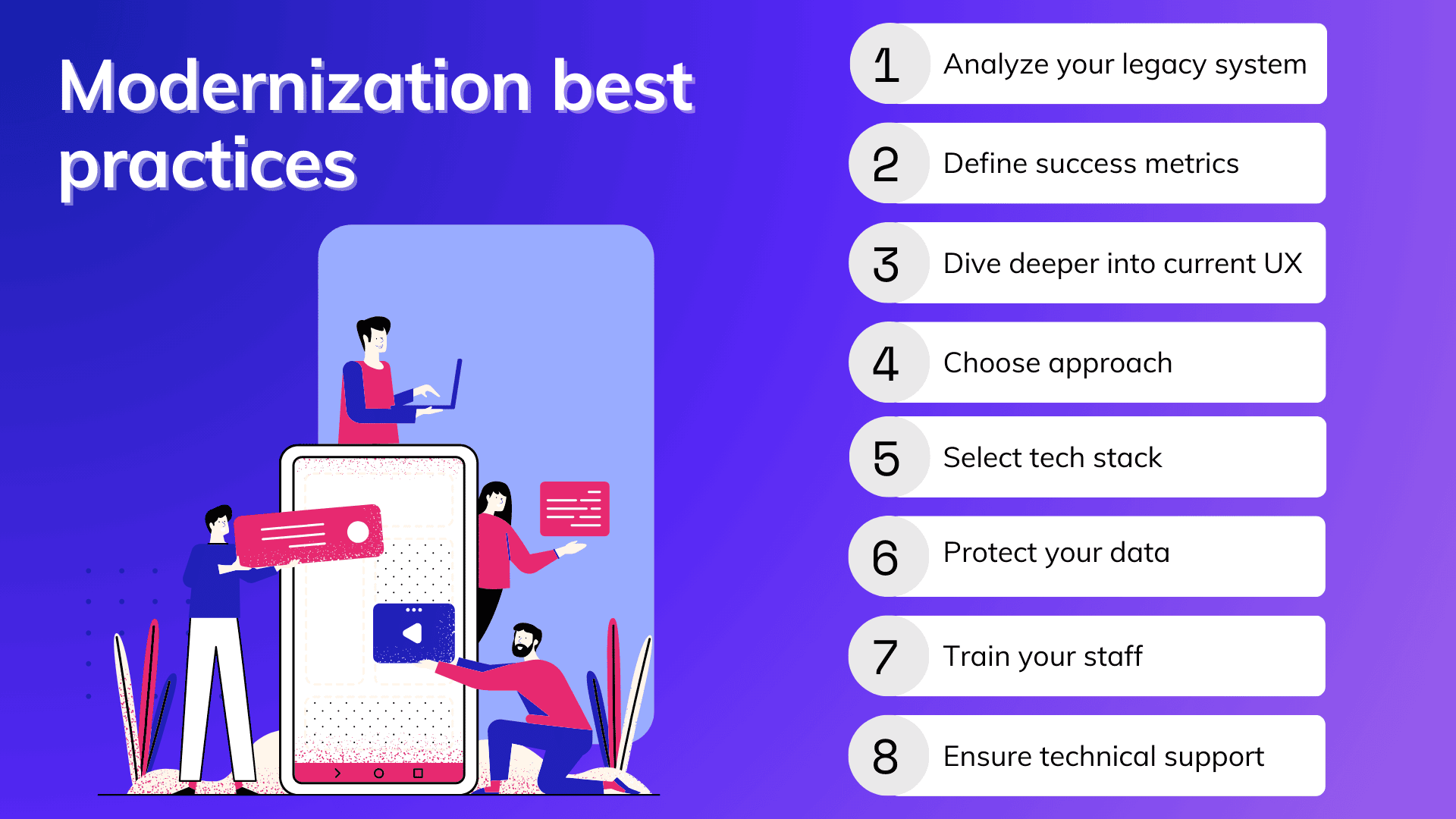
Before you embark on your journey, you might feel overwhelmed with plenty of modernization options. How do you sort them out and know where to start? You need to understand that legacy app transformation does not narrow to development only. It’s a more complex process that requires aligning business goals, engineering solutions, and users’ perspectives. Having these 3 critical components balanced, you can break down the procedure into simple and logical steps.
Analyze your legacy system
Modernization will be effective if you identify the issues accurately – both from business and technical viewpoints. It’s important to define the requirements that currently cannot be met. for this, evaluate the following key drivers:
- Business fit
- Business value
- Agility
- Cost of ownership
- Complex managing
- Security risks
Next, think about the features you’d like to introduce in the course of modernization. Weigh all the pros and cons to make the final decision. This will help you to find out whether the modernization is worth the effort and investments.
Define success metrics
Modernizing an app chaotically and thoughtlessly will not bring the expected result. This must be a structured and carefully planned process. Make sure to set clear objectives so your team knows what to focus on. Define key success metrics and track them to see how transformation affects the overall system’s performance. These might include the following:
- Reduced maintenance cost
- Improved performance
- Increase uptime
- Higher installation rate
You should monitor such indicators to ensure you’re moving in the right direction.
Dive deeper into current UX
Take time to analyze current user interactions with the system. Identify the issues they encounter as well as positive aspects. After all, every system is designed for users and is supposed to provide smooth and effortless navigation.
To obtain a better understanding of the user experience the existing system offers, you can do the following:
- Collect and process user feedback
- Revies previous changes to see which were useful
- Study similar apps to spot the patterns that users are familiar with
- Define the main reason for the UX debt
Pick up the suitable approach
Before introducing any changes you should thoroughly review the available options and select the most suitable ones. With the right approach, you will get the best deliverables while putting in minimum effort and saving time. Determine the parts that provide a unique value and are better to be maintained as well as those which should be completely changed. Base your decision on your goals, assessment, and constraints.
Build your IT roadmap considering the most common modernization strategies:
- Encapsulating the app’s data and making it accessible for integration with other applications through APIs.
- Rehosting (lift-and-shift) by moving the application to a new environment without making significant changes to its code.
- Replatforming means making minimal changes to the existing code and migrating it to a different platform.
- Refactoring requires restructuring the application’s code without changing its external behavior.
- Redesigning the application’s architecture to make it more scalable, flexible, and maintainable.
- Rebuilding the application from scratch using modern technologies.
- Completely removing and replacing legacy systems.
Select the right technology
When business targets are set and communicated to the team, you can move on to the main part of the process, namely app modernization. Choosing the right future-proof tech stack is crucial for increased efficiency and a successful outcome.
There isn’t a one-size-fits-all answer to the best tech stack for legacy app modernization, as the optimal stack will depend on various factors such as the specific requirements of the application, existing infrastructure, budget, and team expertise. However, a common approach to modernizing legacy applications involves the following components:
- Frontend and Backend frameworks
- Databases
- Cloud services
- DevOps tools
- Monitoring and analytics tools
Protect your data and map to business processes
You have to ensure critical data accessibility and protection during the process of app modernization. It’s essential to inventory the data you store and the related business processes to ensure uninterrupted operations during any migration or updates. You can also review your data for pieces that are no longer necessary. There might be data that can be eliminated. This way you can save the time and effort needed for data migration.
Organize staff training
Work doesn’t stop once changes are made and the legacy system is up and running. There are a few more important processes to carry out. Staff training is one of them. You have to introduce the new system to the ones who will use it. Bring a support team responsible for responding to any inquiries and designing a comprehensive guide on how to utilize the modernized app.
Change adoption can be quite challenging. But with well-organized preparation and introduction, you can speed it up, give users a better vision of the updated system, and make the most out of your effort.
Ensure technical support
This means investing in long-term profits. Plan for regular software updates in the future to keep your system relevant for a long time. Otherwise, it will soon become another outdated app you will have to modernize again. Engage a technical support team to monitor issues at early stages and fix them before they escalate and hinder enterprise productivity and growth.
Final thoughts
The modern world of technology is marked by rapid change, high dynamics, and an extensive range of advanced solutions. Staying competitive in this environment requires constant innovation and adaptation to ever-changing conditions. Legacy app modernization is a crucial step for businesses looking to remain relevant in the digital age.
Legacy applications, while critical to business operations, can hinder progress, scalability, and efficiency, pose security risks, and affect a company’s reputation and competitiveness. It may be difficult to timely spot the need for modernization because a system can run without any disruptions yet fail to meet market demands. However, once you see the signs, you should start planning the transformation strategy by considering a number of vital factors.
Modernization offers a solution to many challenges, enabling businesses to implement new features, enhance operational efficiency, and reach their targets.
By following a well-structured process and focusing on specific business demands, organizations can successfully update their legacy applications and keep on evolving in today’s fast-paced digital landscape.