

Distributed Ledger Technology (DLT) in Legal Tech


Distributed ledger technology (DLT) use to share information. It is a distributed registry. Its peculiarity lies in the fact that data is not stored centrally. Instead, a more flexible system is used. The information is updated by the network participant but not only by a central administrator.
The use of DLT has many advantages. This is a timely update of data that other network participants can verify. To get a consensus, it is necessary that all participants in the network vote. Moreover, all system nodes need to approve this action to change the information stored in the database.
Classification of DLT and their features
There are several types of distributed ledgers. There are public, private, and federated DLTs. Each of these subtypes has characteristics that determine its purpose. Let’s look at each of them.
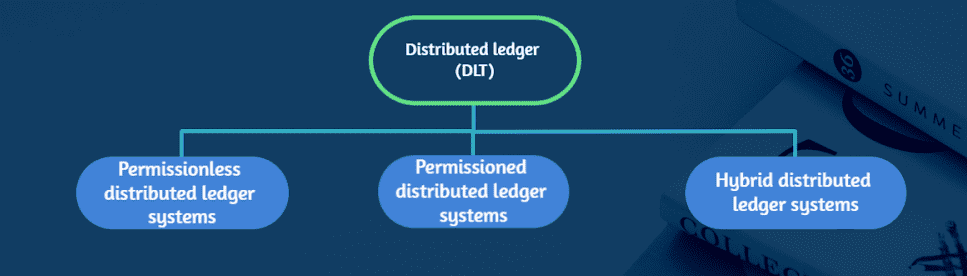
Permissionless distributed ledgers are open-source databases. They allow any user to join the change process. Such DLTs are used in cryptocurrencies.
A centralized node manages hybrid distributed ledgers. They can have public access, but only the central authority changes them. DLT of this type is used for the work of companies, as well as for auditing.
Permissioned distributed ledgers are managed by a group of individuals with appropriate access to record and modify information. In such databases, everyone will not be able to change the data. The scope of use of such DLT is mainly the banking sector.
Making changes to the distributed registry is possible thanks to cryptography. Thus, actions aimed at working with data are available to authorized users. This significantly improves security in working with information, for example, in large companies.
Tweet
Differences between DLT and blockchain
If we talk about the differences between these two concepts, it is essential to understand that the blockchain is just one of the subtypes of distributed registries. Blockchain is DLT with a specific set of functions. It is the same database that is shared. The blockchain consists of closed blocks with a cryptographic signature – a hash. The next block starts with the same hash.
What does this feature give? Using a cryptographic signature allows you to check whether the information in any of the blocks has changed. The presence of a hash means that the information was not manipulated. Therefore, the blockchain is used where it is significant to store data securely and by strict rules, for example, in the banking and legal sector.
DLT technology in legal tech
In some cases, blockchain is used in legal tech. The advantages of this technology allow it to be implemented in transactional legal services and business expansion. Due to its security through cryptography, the blockchain is a convenient and secure tool. With its help, lawyers can solve their tasks of working with clients and perform company duties.
Smart contracts and blockchain
Instead of ordinary contracts, smart contracts can be used DLT. Lawyers can apply smart contracts with the terms of the agreement. They are self-executing codes. Such a smart contract unfolds after specific criteria are met. You don’t need an intermediary to execute them. With the help of smart contracts, lawyers can receive payment automatically after the contract criteria are met.
To understand the role of blockchain in legal processes, it is essential to know that this technology can be used anywhere where authentication or signatures are required.
Notarization with DLT
Authentication verification and the presence of a cryptographic signature that is present in the blockchain is an important points that will make it easy to provide proof of existence to various companies around the world.
All the necessary information is easy to protect and then view along with the timestamps with the help of hashing. All this is achieved because each document, with the help of the blockchain, receives its unique digital identifier. If you use it, you can check all subsequent versions of this document without having to share it.
Intellectual property and DLT technologies
Protecting intellectual property in digital transformation is a topical issue for lawyers. The more the world goes online, the more intellectual property theft occurs. Through DLT, lawyers can obtain evidence of the first use of an object. This will allow intellectual property owners to prove their rights to it more effectively. In addition, this technology will enable you to track the supply chain from the supplier to the customer. Therefore, its use is relevant for processes with a high risk of counterfeiting.
The use of DLT in the work of lawyers is one of the most modern and practical technologies. With its help, professionals get more time to focus on their professional tasks.
Distributed registry technology reduces the amount of paperwork and simplifies the interaction between lawyers and their clients. Therefore, adapting the legal sector to the conditions for implementing DLT solutions is important.
Tweet